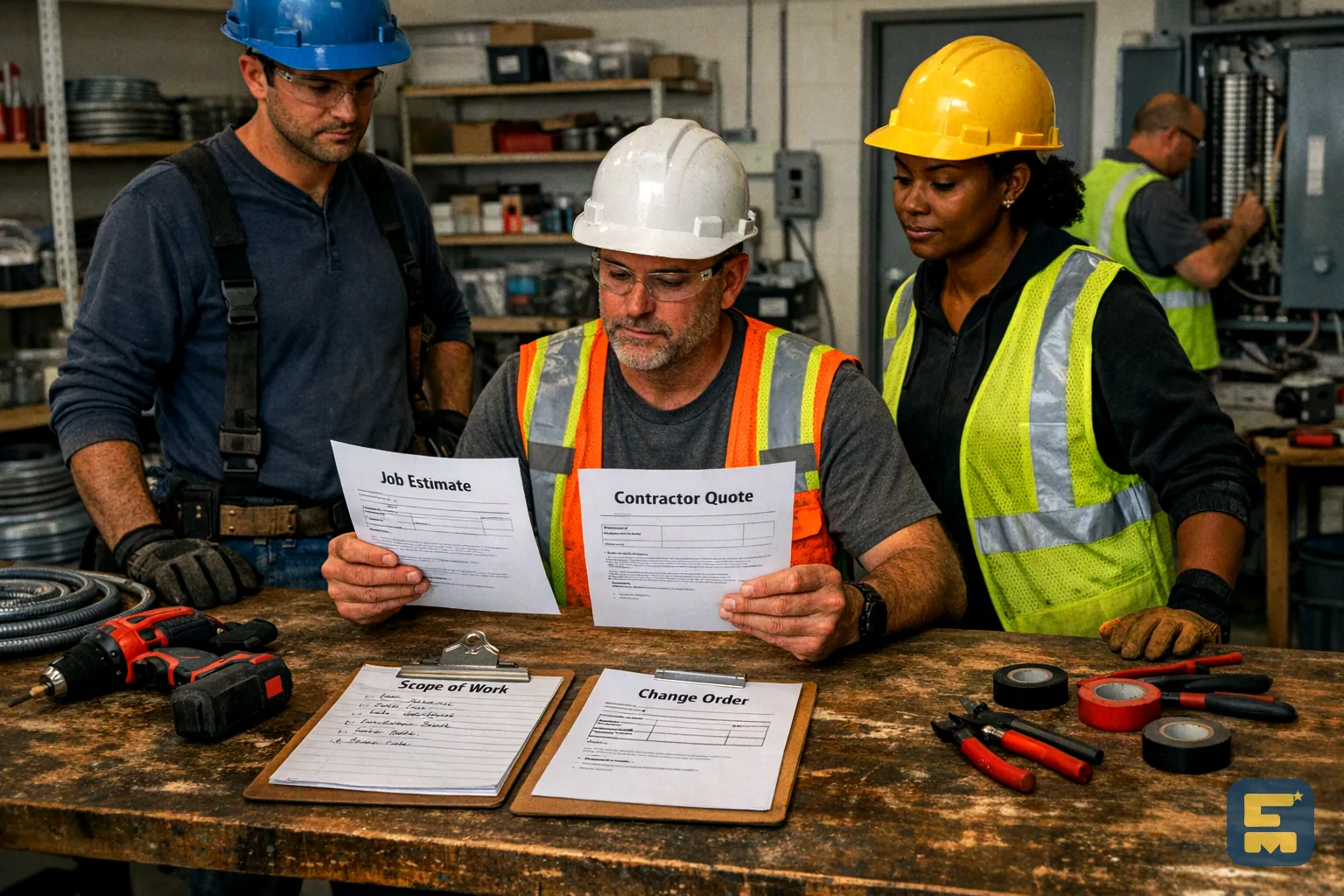
A customer wants a price before you have checked access, measurements, or existing conditions. The contractor estimate vs quote decision comes down to certainty: estimate the unknown job, then quote the defined job.
Contractor estimate vs quote: match the document to what you know
An estimate is a provisional assessment based on the information available. It may state a likely amount or range, but it should also show what remains unknown.
A quote states a price for defined work. It relies on clear inclusions, exclusions, assumptions, and a written process for changes.
Neither document is always better. The wrong document is the one that pretends an unknown condition has been settled.
Use an estimate while the job has open questions
Start with a job estimate when you have not confirmed quantities, access, equipment selections, hidden services, site conditions, or work by other trades.
A phone request is not a site inspection. If the customer describes a noisy unit, a leaking pipe, or a room that needs new fixtures, list what you still need to inspect before fixing a price. Access and existing systems matter on HVAC jobs. Concealed pipework and damaged surfaces can change the scope of plumbing work.
State the basis of the estimate. Note whether it came from photos, customer measurements, a phone description, or a site visit. Then state what happens next.
Use a quote when you can draw a clear line around the work
Issue a contractor quote after you can describe the tasks, location, quantities, materials, exclusions, price, and change process.
Do not hide uncertainty. Turn it into a stated assumption, an allowance where appropriate, or an exclusion. If you cannot control the unknown, stay with an estimate until you can.
Before choosing the document, mark every unchecked condition on the job record.
Move from a job estimate to a contractor quote at the inspection gate
Inspect access, measurements, existing work, material selections, and trade boundaries. Write any remaining unknowns as assumptions or exclusions before you issue the quote.
This is the contractor estimate vs quote handoff. Do not move forward because the customer wants a firm number quickly. Move forward because you can support the number with a defined scope.
Check permit and inspection questions with the local building department. Check contractor license questions with your state contractor licensing board. For electrical, plumbing, or mechanical trade license questions, check the relevant state or city licensing office.
Write the estimate around uncertainty
A useful estimate tells the customer what you know, what you do not know, and what must happen before you can issue a firm quote.
Include:
- Customer name and job address
- Requested work
- Information used to prepare the estimate
- Expected cost or range
- Conditions not inspected or confirmed
- Material or equipment selections still required
- Issue date
- Next inspection, measurement, or selection step
- Any charge for further pricing or diagnostic work
Keep the label and wording consistent. Do not title the document “Estimate” and then describe its price as fixed.
A copy-ready structure can stay simple:
JOB ESTIMATE
Customer: [name]
Site: [address]
Requested work: [brief description]
Estimate basis: [photos, phone details, plans, or site visit]
Estimated amount or range: [amount]
Not yet confirmed: [access, quantities, selections, existing conditions]
Exclusions: [work not assessed]
Next step: [inspection, measurements, selections, or detailed quote]
Issue date: [date]
Customer acknowledgment: [name, date, and method; confirms receipt only and does not authorize work]
Use the estimate to show what must be inspected, measured, or selected before you issue a quote.
Build the quote from scope, cost, and markup
A contractor quote needs enough detail for the crew to know what to do and the office to know what to invoice.
Describe concrete work. Name the room, unit, surface, fixture, or section of the site. Record quantities. State who supplies each material or piece of equipment. Separate included work from excluded work.
Build the price from your own job costs:
Labor
+ materials
+ equipment and subcontractor costs
+ other direct job costs
+ overhead allocation
= cost subtotal
+ markup amount applied to the cost subtotal
= quoted price
Use your own figures. The how to price a job guide explains how labor, materials, overhead, and markup fit together without confusing markup with margin.
Your quote should also state:
- Quote number and issue date
- Customer and site details
- Defined scope and quantities
- Included materials or equipment
- Exclusions and assumptions
- Total price and payment terms
- Customer access responsibilities
- Responsibility for permits, inspections, cleanup, and other trades
- Acceptance method
- Process for change orders
Record acceptance before scheduling the crew or ordering job-specific materials.
CONTRACTOR QUOTE
Customer: [name]
Site: [address]
Scope: [tasks, locations, quantities, and materials]
Included: [included work]
Excluded: [excluded work]
Assumptions: [conditions supporting the price]
Price: [amount]
Payment terms: [terms]
Access and site responsibilities: [details]
Permits and inspections: [responsibility]
Change orders: Extra or changed work requires written approval before work proceeds.
Acceptance: [name, date, signature or recorded approval method]
Make exclusions work on site
An exclusion is useful only when the crew can recognize it and stop before crossing it.
Consider the house electrical example. All figures below are sample currency units for a worked example, not market prices or a rate card.
R. Chen requested a bathroom exhaust fan, 150mm and ducted through the roof, plus four LED downlights at 14 Oak Street. Estimate E-1847 gave a range of 900–1,400. After the work was defined, Quote Q-1847 set the total at 1,105.
The ceiling was lined, and the quote excluded chasing. Extra cable and chasing were then approved on site as a 160 change order. Invoice INV-1847 was 1,265.
The exclusion kept chasing outside the accepted scope. The approved change order documented the extra 160 and explained why the invoice was higher than the quote. Contractors handling similar scopes can keep job details together with the right electrical job records.
Review exclusions with the person doing the work. A sentence buried in the office file will not stop an unpriced extra on site.
Stop and write a change order when the job moves
A customer points to an extra task while the crew is already working. That does not make the task part of the accepted quote.
Stop before completing it. Write down:
- The added, removed, or changed work
- Why the scope changed
- The effect on price
- The effect on timing, if any
- Who approved it and when
Get recorded approval. Then continue. Keep the accepted quote unchanged and attach the change order to the same job.
Do the same when the cause is a hidden site condition rather than a customer request. The trigger is a change to the accepted scope, not who noticed it.
Reconcile the invoice to the accepted documents
Start with the accepted quote. Add or subtract only approved change orders. Then account for deposits, progress invoices, and credits already recorded.
Every invoice line should trace back to the quote or an approved change order. If the office cannot explain a higher total, stop the invoice and find the missing record.
Yes Foreman can keep the estimate, accepted quote, approval, change order, and invoice attached to the same job. Crews can also record job changes from the field before the extra work disappears into an invoice note.
Common questions
Do contractors charge for a quote?
Your business may choose to charge for a quote or estimate, subject to state licensing and consumer-contract requirements. Check licensing requirements with your state contractor licensing board, get local legal advice on consumer-contract requirements, and disclose the fee before the visit. State exactly what the charge covers.
What is an estimate from a contractor called?
Customers may call it a job estimate, cost estimate, written estimate, or preliminary estimate. The label matters less than consistent wording. Make it clear that the amount is provisional and list the information still needed.
How legally binding is a quote?
When the contractor estimate vs quote choice affects contract terms, the document title does not settle enforceability. Check any quote or contract terms required as part of your contractor license with your state contractor licensing board, and get local legal advice on whether the wording and acceptance method are enforceable.
Pre-start gate
- Mark every unknown condition.
- Inspect access and existing work.
- Write plain inclusions and exclusions.
- Check the price against your job costs.
- Record acceptance before scheduling.
- Brief the crew on change-order triggers.